
 English
 Italiano
 Français
 Türkçe
Request quotation
The maximum load is the maximum allowable tonnage at which tools can be used without getting damaged. By "damages" we usually mean permanent deformation or breakage.
How is it calculated?
The maximum load is measured in Ton/m (Tons per meter), and it is calculated through specific software, according to the ultimate tensile strength of the material and the force exerted on the punch. The thinner inclined sections of the body of the punch and the sections where torsional load is applied are taken into account.
A safety factor is then added to the result, as is done for any system where a load is applied, in order to define the maximum stress value. This is the point below which the tool can be used without permanent deformations.
What happens if this value is exceeded?
Exceeding the maximum load of a punch. When under excessive pressure, a punch can:
- be permanently deformed;
- break.
Case A: permanent deformation.
What happens exactly? Deformation reduces the height and moves the tip away from the bend axis, usually towards the relief (for gooseneck punches), or on its own axis (towards the clamp). According to the amount of pressure and the size of the deformation, it can or cannot be visible.
Common mistakes and related deformations.
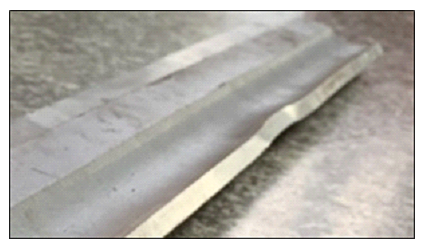
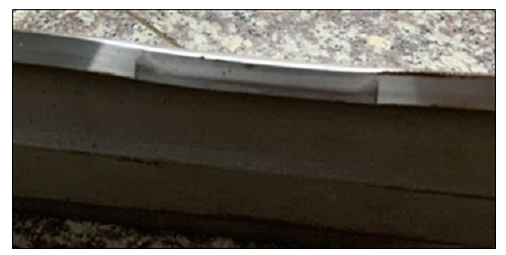
These two pictures show a punch that was deformed by a very frequent mistake: not considering the effective bend length.
Specifically, this punch has a maximum capacity of 100 Ton/m, but the machine operator tried to bend a really short and thick sheet metal, and the die used was too small. The operator set the press brake so that it would apply its maximum force (80 tons). The whole load was applied on an effective length of approximately 20 cm: 80 Ton on 0,2 m.
With a simple equation:
80(Ton) : 0,2(m) = x(Ton) : 1(m)
x=400 To
This means that the portion of sheet metal between punch and die (and therefore the same portion of the tools) was subject to a pressure of 400 tons per meter.
With a similar equation, let us see how deformation might have been avoided.
1. Lower tonnage
100 (Ton) : 1(m) = x (Ton) : 0,2 (m)
Maximum tonnage allowed should have been 20 Ton.
2. Greater length
100 (Ton): 1 (m) = 80 (Ton) : x (m)
Length of sheet metal should have been at least 0,8 m.
When the pressure applied exceeds the punch capacity, but it is not so high as to cause failure as in the above picture, the damage caused is less visible. In such cases, accurate measurements and instruments will be necessary to determine the height reduction and the axis shift.

This punch was used to align the dies. Such operation is carried out by installing dies with the same angle as the punch tip, and selecting a stroke that allows the punch to fully penetrate into the die.
In this case, the damage is caused by the dies having a smaller angle than the punch tip angle.
In confirmation of what was said earlier, it is important to notice that deformation occurred in the point where compressive force deviates and on the thinner sections. The next article is going to focus on how exceeding the maximum capacity can lead to case B, that is, breakage.
Eurostamp, Top quality tooling.
Do you want resistant and high-performing press brake tools for your press brake? Choose Eurostamp: since 1970 we have been leaders in designing and manufacturing high-precision press brake tooling.
Contact Eurostamp.