
 English
 Italiano
 Français
 Türkçe
Request quotation
Giuseppe Speroni, Head of Technical Office at Eurostamp.
This article is going to focus on a really particular type of sheet metal bending: offset bending.
What is offset bending.
To put it simply, it is a type of bending where two or more bends are formed close together using only one tool.
Types of offset bends.
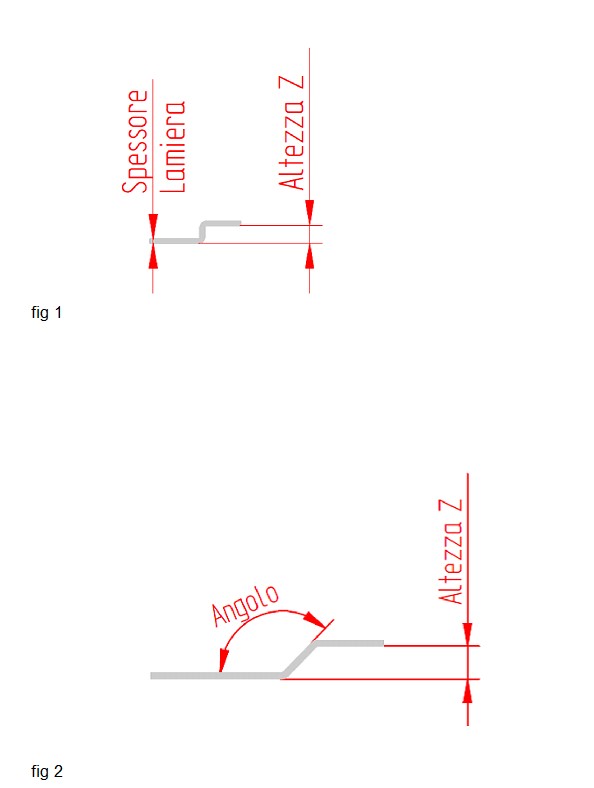
There are two types of offset bends (Z bends):
- 90° offset bend (Fig. 1)
- other than 90° offset bend (partial bending) (Fig. 2).
Which bending tools are required to form offset bends?
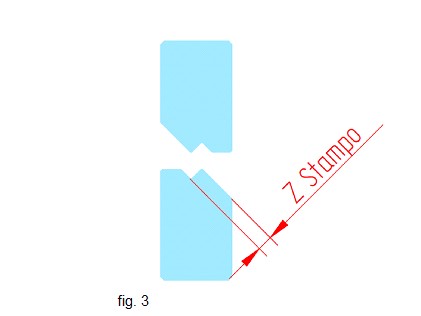
This operation requires special tools, to form two bends with a single stroke. 90° offset tools (Fig. 3) can also be used to form bends other than 90°, just by controlling the depth of the punch. Offset bending for other than 90° bends is an "air bending" operation, while 90° bending is a "coining" or "bottoming" operation.
When and why is offset bending used?
There are mainly two reasons to choose this bending:
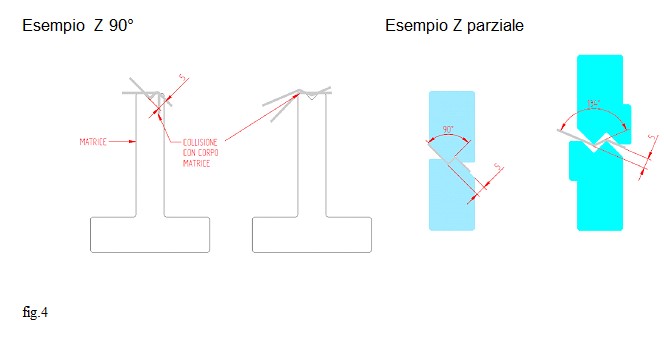
- we have two or more bends to be formed really close together, which cannot be formed using standard tooling (Fig. 4), since the sheet metal would collide with the die.
- we want to speed up the bending process. Making more bends at one time is, indeed, a great timesaver.
Limitations of offset bending.
Since making more bends at a time requiresa greater bending force than standard bending, we will have some rues to follow.
We will also have some limitations in terms of:
- sheet metal thickness
- type of material
- height of offset.
We have already mentioned that for 90° offset bending, a great amount of bending force is required. This means that we cannot carry out this type of bending on high thickness sheet metal.
90° offset bending can only be carried out on very thin thicknesses, under 1,5 mm. Another factor to be taken into account is that the lower the height of the offset needs to be, the higher amount of bending force is required.
All these considerations lead us to state that it is practically impossible to achieve a 90° offset equal to the sheet metal thickness, as we would risk "cutting" the material rather than bending it. When the offsets must equal the sheet metal thickness, we have to apply partial bending.
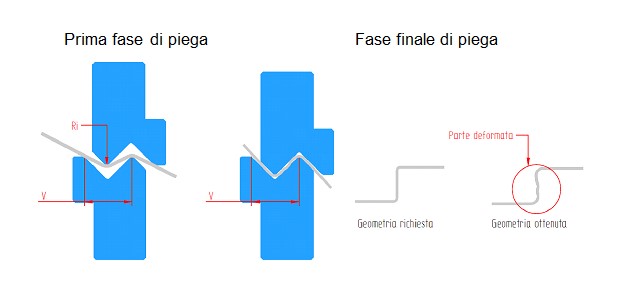
Even when the offset is far greater than the sheet metal thickness (10 times greater or more), there are specific issues. In this particular case, during the first bending phase, the result is a large inside radius (Rp). The final bending phase results in exceeding material that cannot be bent inside the mold.
This leads to wrong angles and deformation of the central part of the workpiece. In order to limit this compression phenomenon, one solution is to increase the inside radii, so as to reduce the amount of exceeding material in the final bending phase.
The next article is going to continue analyzing this type of bending, focusing on the flanges.
Do you need any help with offset bends?
Contact Eurostamp.
Our technical office is available to respond to any requests in order to find the best strategies for any type of bend. Since 1970 we have been manufacturing top quality press brake tooling, with the highest level of precision, resistance and reliability.