
 English
 Italiano
 Français
 Türkçe
Request quotation
The previous article focused on the maximum capacity of punches. We mentioned that when tonnage exceeds the maximum allowable tonnage per meter of a tool, the tool gets damaged. Such damages can include deformations - already taken care of in the previous article - or breakage.
This article is going to focus on the second case.
Broken punches.
One of the most frequent reasons that cause a tool to break is that the body of the tool is too hard. The body of the tool should never be too hard; it should instead be quite ductile.

Have a look at this image of a tool deformation: if the body of such tool had been excessively hardened (through heat treatments), instead of just being deformed it would have immediately broken. By suddenly breaking, it would not only have compromised the workpiece quality, but it would also have thrown dangerous shards all around.
When does a punch break?
When pressure exceeds the yield point and reaches the ultimate tensile strength (UTS), the punch breaks - usually at the thinnest point of the body.
Read this article to find out more about ultimate tensile strength and yield strength.
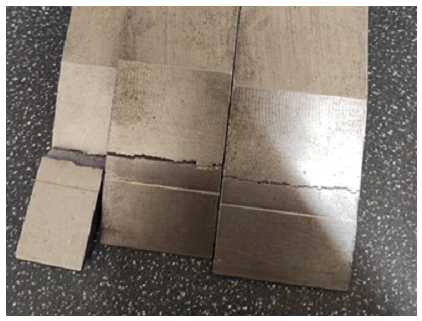
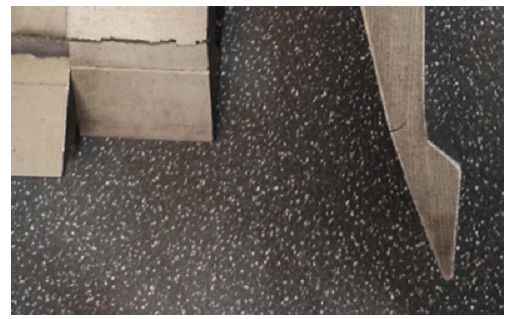
These photos show that, thanks to a low hardness value, no fragments were thrown. The damage started from a crack which extended gradually until the tool broke into two parts.
Other reasons that might damage punches.
We talked about cases of punches suffering damages with pressure exceeding its maximum tonnage capacity.
However, the durability of a punch might also be compromised by other causes, different from the ones we have talked about so far. Obviously, the weakest parts of a punch are those mainly involved in metalwork, such as the punch tip.
Let's see some more causes of damage:
- if the punch tip is used on sheet metal with abrasive surface, or on corrugated sheet metal, it might suffer premature wear and tear;
- if there is a major difference between the punch tip radius and the sheet metal thickness (or the inside bend radius, which in turn depends on the die opening width).
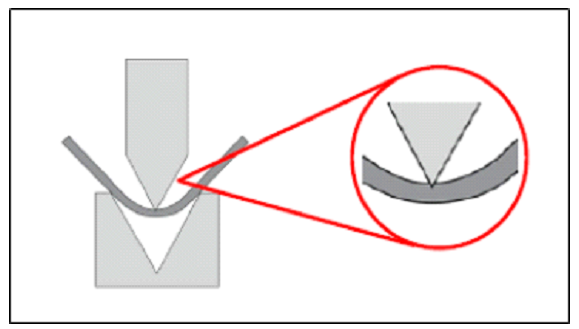
In these cases, excessive pressure applied on the punch tip - too small compared to the thickness - causes premature wear and tear. Besides, such situation might increase the risk of perforating sheet metal.
Do you want to avoid damaging your punches?
Always choose high quality and high resistance tools, suitable for any metalwork. Investing in high quality press brake tools means to have instruments available that are able to bear the heavy loads of sheet metal bending, resist the repetitive cycles of metalwork and the abrasion wear caused by sheet metal sliding.
Since 1970 Eurostamp Tooling has been designing and manufacturing top quality press brake tooling, industrial punches and industrial dies.
Discover the full range of Eurostamp's tools.