
 English
 Italiano
 Français
 Türkçe
Request quotation
Let's continue talking about the strength of a high quality tool. In this article, we are going to focus on how strength can also be determined by the shape of the tools.
An overview of tool shapes.
We will begin by analyzing the upper tools, as they are most subject to wear and tear. To start with, punches can be divided according to their geometry and related characteristics.
Classification of punches according to their shape.
Standard punches are divided into two main categories:
- straight punches,
- gooseneck punches.
Obviously, these two types of punches are not the only types available, but any tool in the catalog can be included in one of these two macro-categories.
Have a look at Eurostamp's catalog.
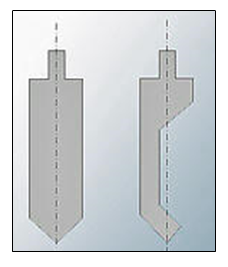
Why is shape so important?
The shape of the punch is fundamental to create certain bent profiles. In addition, and more importantly for our analysis, the shape of the tool also determines its max. load, expressed in tons per meter (Ton/m).
This is due to the fact that when we apply force to the upper part of the tool, it goes down along the punch body and reaches its tip. From the tip, the force then transfers to the sheet metal.
Let’s now analyze the two categories and their properties.
Straight punches.
In straight punches, the force applied by the press brake only travels through the body of the punch. Force goes down along the punch, parallel to the tool axis. The whole body of the tool only experiences a compressive stress.
Straight punches with the right width have a very high max. load. In these cases, the constraint often comes from the dimensions of the clamping system because the same force going through the punch needs to pass through the clamping systems as well.
These are also stresses expressed in Newton (N) or Kilograms (Kg) applied on surfaces (expressed in mm²), that is, the ultimate tensile strength of the material of which such surfaces are made of (expressed in N/mm²).
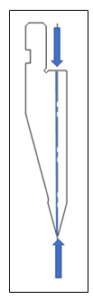
Exceeding ultimate tensile strength.
When ultimate tensile strength is exceeded, deformations or damages might occur.
Specifically:
- when the stress (Kg) applied on a surface (mm²) exceeds the ultimate tensile strength UTS (Kg/mm²), said surface is damaged
- when yield strength YS is exceeded, the material deforms permanently (bent or compressed - embossed).
Gooseneck punches.
In gooseneck punches, compressive stress passing through the body of the punch needs to deviate to follow its shape.
As a consequence, some parts of the tool are subject to transverse forces that tend to twist them (torsion). The longer the parts subject to transverse forces, the longer the lever arm (or moment arm). This results in gooseneck punches having a lower load-bearing capacity, and therefore a lower max. load.
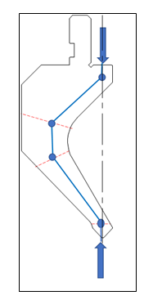
The max. load of a tool and its axis.
The max. load of a tool also depends on its axis. The max. load of a tool tends to change depending on the portion of axis that is outside the body of the tool.
The next article is going to continue focusing on the shape of tools.
Do you need help to choose the best punches for your bending operations?
Since 1970, Eurostamp has been designing and manufacturing top quality press brake tooling, industrial punches and industrial dies.
Discover Eurostamp's competences.