
 English
 Italiano
 Français
 Türkçe
Request quotation
In this article we are going to focus on how toughness and durability of tools can depend on which type of steel they are made of.
Look into the 3 parameters to recognize a high quality tool.
In the previous article we saw how choosing the most suitable press brake tool is not simple: the tool has to fully meet all our needs of use. A high quality tool is one that has specific characteristics which allow to achieve top quality finished products.
The first of these characteristics is the toughness - durability of the press brake tool. In order to fulfil this requirement, the tools have to:
- bear the heavy loads applied in sheet metal bending (crush resistance, both for punches and dies)
- resist the repetitive cycles of metal processing (fatigue resistance, both for punches and dies)
- resist the abrasion wear caused by sheet metal sliding (surface hardness, mainly for the dies).
One of the factors providing the tools with these characteristics, thus increasing their toughness and durability, is the type of steel used to fabricate them.
Let's now go through the mechanical aspects of steels used to fabricate press brake tools.
Steel mechanical properties and how to measure them.
The mechanical property of a material is its ability to resist forces and stresses that are applied to it when it is being used. These might be different kinds forces, for example static - applied gradually and continuously, or dynamic, like those occurring when bending a material. Let's focus on which fundamental mechanical properties should always be considered when choosing the type of steel.
Ultimate tensile strength.
The ability of steel to withstand a force depends on its ultimate tensile strength (UTS), often shortened to tensile strength (TS).
It is a mechanical property, found by performing a tensile test, which determines the maximum amount of unidirectional tension that a section (area) of material can withstand before breaking.
The result is measured in Newton per mm² (N/mm²) or in Kg/mm² (1Kg = approx. 10N). This value represents the amount of stress (tension) that a square millimeter of the tested material can withstand.
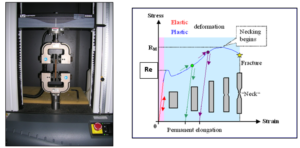
The curve shows material Strain (X-axis) in relation to Stress (Y-axis) and the UTS point (ultimate tensile strength).
Yield strength.
The curve also shows another key factor: Yield strength (YS). YS is also important because any amount of tension beyond yield point, while not being enough to break the material, will cause a permanent and non-reversible deformation.
In other words, when tension load is below yield point, the deformation of the material is only temporary. The material will go back to its original shape when the load is removed. Conversely, if the tension load is beyond yield point, the material will undergo permanent deformation and when the load is removed, it will not go back to its original shape.
The next article is going to focus on how the strength value can be increased though heat treatments, which affect mechanical properties of steel.
Do you need assistance?
Eurostamp replies promptly to any queries and provides training support in bending. Since 1970 Eurostamp Tooling has been designing and manufacturing top quality press brake tools, industrial punches and industrial dies, standard tools or special tools.
Discover Eurostamp's skills.