
 English
 Italiano
 Français
 Türkçe
Request quotation
In the previous articles we saw different types of bending, such as coining and air bending. This article, with the help of Head of Technical Office Giuseppe Speroni, is going to focus on hemming.
It is used to:
- create edges that are safe to handle
- reinforce thin sheet metal.
The first goal is the most frequent. Thin sheet metal without hems along the edges might be sharp and cutting, and this can be dangerous when holding or handling it. As we previously said for radius bending, hemming is also required in many sectors, such as home furniture, office and sports furniture, sheet metal cabinets and many more similar products.
How hemming is performed.
The hemming technique, which requires specific tooling, is usually performed in a two step process:
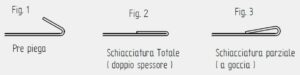
- pre-bending (Fig. 1) creating an angle ranging from 35° to 26° (according to the sheet metal thickness) obtained with standard bending
- flattening process where the bend is completely (Fig. 2) or partially closed (Fig. 3).
Stainless steel or carbon sheet metal is particularly suitable for this type of bending as it does not break, despite a really small bend angle. In case of other types of material, it is recommended to ask the supplier if they are suitable for hemming.
Thickness.
Hemming is usually performed on thicknesses ranging from a minimum of 0,6 - 1,5 mm. Naturally, the thicker the sheet metal, the more bending force must be applied. The maximum thickness for hemming is 3 mm. With such thickness, hemming is used to reinforce the material, rather than making edges safer to handle.
Eurostamp, more than 3700 clients worldwide.
Eurostamp faces this and other types of bending with the best press brake tools. Since 1970 Eurostamp Tooling has been manufacturing and selling top quality press brake tooling and equipment. We design standard and special tools. We have customers worldwide who choose us for our professionalism, skills, precision and fast delivery.