
 English
 Italiano
 Français
 Türkçe
Request quotation
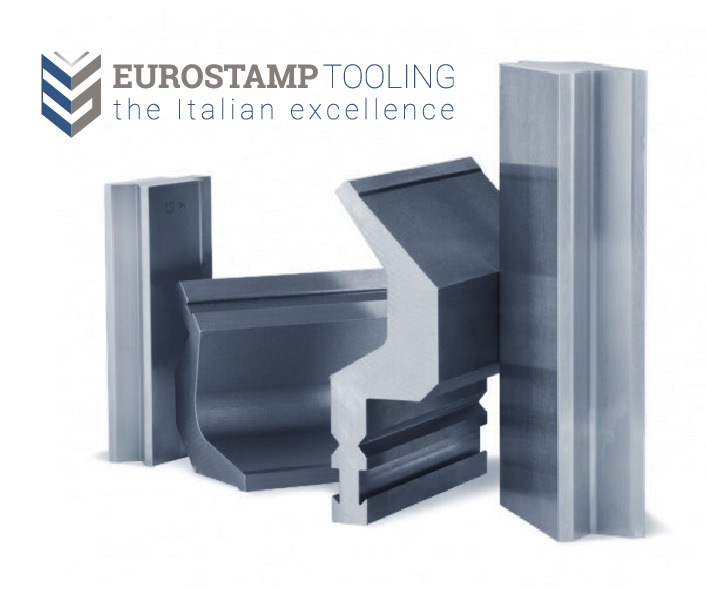
In this article we mentioned how important it is to carry out heat treating processes to obtain resistant, hard and durable tools.
From a technical point of view, these processes create protective layers or alter the physical and chemical properties of the tools.
Press brake tools undergo one or more heat treatments to improve their performance during the bending operations.
More specifically, we are talking about punches and dies, which are the tools involved in sheet metal bending. Since they need to provide high performances and functionality, even when subject to stress during bending operations, they are thermally treated.
Thanks to these treatments, the tools can:
- bear heavy loads
- resist the repetitive cycles of metal processing
- resist the abrasive wear caused by sheet metal sliding.
– You might want to read: 3 parameters that define high-quality press break tools.
As already mentioned, Eurostamp mainly applies two types of heat treating processes: nitriding and induction hardening.
After a brief overview of the hardening process, this article is going to focus on induction hardening.
Hardening: what is it?
This process consists of heating metal to high temperatures for a given time, and then cooling it rapidly in order to alter its mechanical properties (e.g. hardness, ductility and tensile strength).
Depending on:
- the temperature reached during the heating phase
- the rate at which the temperature is reached
- how long the material is held at this temperature
- speed
- cooling method,
it is possible to obtain different values for the above properties. The mechanical property that we tend to alter in press brake tools is hardness. Because hardness is directly related to fragility (for example, glass has great hardness values, but it is also extremely fragile), these properties need to be balanced. This is the reason why we chose to apply induction hardening.
Types of hardening.
There are four types of hardening: core hardening, induction hardening, laser hardening and flame hardening.
Core hardening.
This is a heat treatment involving both the tool surface and the tool body, it includes a double cycle of heating, temperature holding and cooling.
At the end of the first cycle, the material reaches a very high hardness value, all over the whole tool, but it is full of residual stresses (which tend to deform it). In addition, since hardness is proportional to fragility, this block of steel might break very easily (similarly to a block of glass, if we tried to bend it, it might break and spray out shards of material).
This is the reason why it undergoes a second cycle (called tempering): this "softer" treatment reduces the stresses in the structure and, at the same time, some of the excess hardness is reduced, reaching the right value which is around 40-44 HRC. The usual method to measure hardness is to apply a specific force to an indenter on the tip of the tool, and to measure the penetration depth caused by the indenter.
Induction, laser and flame hardening.
These are surface treatments: they change the mechanical properties of steel only on the desired surfaces (in our case, only those areas that are more subject to wear and tear, damage or deformation).
This solution allows to leave the properties of the "tool body" unchanged, but the "localized" (only where needed) hardness values reached are much higher than the values achievable with core hardening: up to 58-60 HRC.
The three methods differ in how the surface is heated:
- induction hardening, with copper coils
- laser hardening, with laser
- flame hardening, with oxyacetylene blowpipe or blowtorch.
Let's focus on induction hardening: this is the treatment chosen by Eurostamp because it has widely proven to provide the best results in terms of surface hardness with the lowest costs, allowing to offer high quality at competitive prices.
Induction hardening: how does it happen?
It is a particular type of localized hardening, carried out by applying an electromagnetic field created by copper coils to the surfaces that require hardening. When alternating current passes through the copper coils, they create a magnetic field that heats the steel surface. By properly changing frequency and intensity of the current, as well as the shape of copper coils, we can obtain different sizes of heated areas, different heating speeds and different heat penetration depths.
Immediately after heating, the tools are quenched in liquids.
The experience we have gained through the years allows us to properly choose the parameters to apply, depending on the intended result and on the shape of the tool.
Induction hardening: pros.
Induction hardening is widely used as it brings many advantages:
- it is a rapid process
- it is easily controlled
- it is repeatable on tools with different shapes
- it is cost-effective
- compared to core hardening a higher surface hardness is obtained.
Top quality tooling: rely on Eurostamp.
Eurostamp carries out high-quality heat treatments on the tools, ensuring high-performing, functional and extremely accurate products.