
 English
 Italiano
 Français
 Türkçe
Request quotation
In the wide range of press brake tools, you can find several punches with similar profiles and dimensions, but they all differ in one aspect: the dimensions of the punch tip radius. What is it?
In order to clarify it, we need to introduce 3 concepts:
- bend radius
- springback
- type of bending.
1 - Bend radius.
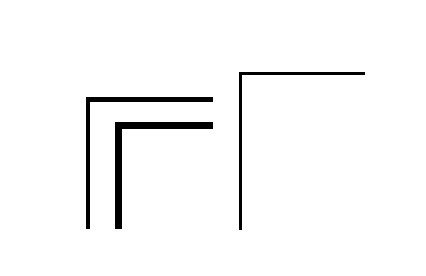
The most intuitive way to represent a bent profile is to use straight lines and sharp corners (without any radius).
Actually, sheet metal has a thickness, which, in a visual representation, clearly shows that it is impossible to achieve bends with no radius or too small radius.
The usual reference unit is the internal bend radius, which must be considered in relation to the thickness.
In theory, the internal bend radius must be equal to the thickness of the sheet metal.
Is it also possible to make bends with smaller radii? Yes, it is. However, the smaller the radius is, the more likely it is to:
- fabricate with low angular accuracy
- damage the tools or the press brake structure
- compromise safety conditions.
2 - Springback.
Springback is the amount of elasticity that any material has, namely the tendency of a material to resist deformation and to revert to its original form.
This factor is always present in metal sheet bending, and it results in wider angle and radius once the part is released from the deforming forces.

3 - Type of bending.
In the past, early press brakes used to be activated mechanically and stroke control systems didn't exist, or if they did, they used to be extremely basic and scarcely accurate. Because it was difficult to control the position of the punch tip in relation to the bottom of the die, the machine had to be operated exactly as a press. That is to say, the sheet metal used to be bent applying the greatest amount of force available to an upper tool, which finally would copy the shape from the lower tool. The resulting angle was thus determined by the shape of the upper and lower tool (angles and radii), which gave their shape to the sheet metal.
First type of bending: coining.
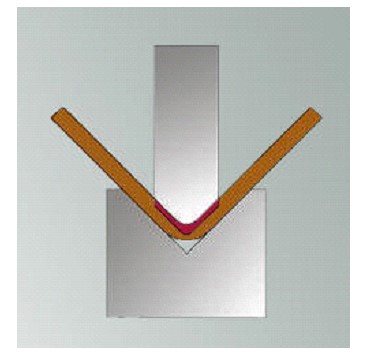
In coining, the punch and die must be an equal match to the angle to be fabricated (usually 90°).
In this case, extremely high force is used. By doing so, the punch tip is forced to penetrate into the sheet metal till its neutral axis, thinning its thickness along the bending line and thus eliminating springback.
In coining, the whole punch tip (its two sides shaped to the same angle to be fabricated, usually 90°) makes full contact with the sheet metal in order to create the same angle (usually 90°), whose internal bend radius is equal to the punch tip radius: this is why, in order to ease the penetration, it is recommended to use very small radius punches (the most common are 0,2 / 0,25 mm); the die must have the same angle as the punch and its V-width should be about 6 times the sheet metal thickness.
Limitations of coining. This type of bending is limited in that it is necessary to use extremely high tonnage, which tends to destroy the integrity of the material and so only very thin sheet is processed (usually no thicker than 1-1.2 mm). As such limitations outweigh the advantages, this type of bending is, actually, only used in a few specific cases.
Second type of bending: bottoming.
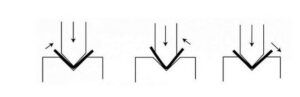
Bottoming originated as a partial remedy to the difficulties of coining because:
- it can use less tonnage
- it can "compensate" springback by using upper tools at a more acute angle than the one to be fabricated.
The selected die angle is the same as the one to be fabricated, but the punch angle is smaller (theoretically, as many degrees smaller as the degrees of springback).
When bottoming, the machine completes a full stroke, so the punch tip is pushed against the bottom of the die.
Springback is compensated thanks to the difference between the die angle and the punch angle, together with the pressure applied by the punch tip radius on the sheet metal, which is already bottomed against the die.
This pressure "forces" the sheet metal to "over-bend" until it contacts the sides of the punch, and then it will spring back against the die.
At the end of the operation, the correct angle is achieved.
In this case, only the punch tip radius makes contact with the metal, instead of the whole punch surface (that is to say, the two sides of the punch and the punch tip radius).
Limitations of bottoming. Compared to coining, bottoming grants a higher degree of control over the bend angle, but even this can prove a challenge due to the tonnage requirements.
The next article is going to focus on the relationship between the punch tip radius and air bending.
Get an insight into Eurostamp, since 1970 leaders in designing and manufacturing top quality press brake tools, industrial punches and industrial dies.