
 English
 Italiano
 Français
 Türkçe
Request quotation
Giuseppe Speroni, Head of Technical Office at Eurostamp.
Sheet metal bending is a process which can be extremely complex.
There are several different types of bending, and therefore several different levels of difficulty in making them.
Among all types of bending, the one that usually gives more problems is the so-called radius bending, in which the internal bend radius is far greater than the sheet metal thickness.
When is radius bending required?
This type of deformation is required in many sectors, such as home furniture, office and sports furniture, sheet metal cabinets and many more similar products.
There are two main reasons for choosing it:
- SAFETY
- AESTHETICS.
It is safer because it avoids sharp edges that might cause harm or bruises to the users.
Especially when sheet metal is very thin, edges are really small and can be a real danger.
Used at the beginning as a precautionary measure, it has later become a real trend, as rounded edges are also favored by contemporary designers.
What is radius bending?
In standard bending, the internal bend radius is usually equal to, or slightly greater than the thickness of the sheet metal.
This condition allows for a minimum springback, thus reducing the differences between the intended internal radius and the internal radius achieved.
This is obviously an advantage in the design and production phase, as it is possible to predict the actual result of the finished pieces.
As a consequence, it will be possible to predict the sheet metal development and the tooling to be used.
Things are completely different for radius bending, as, with an internal bend radius far greater than the sheet metal thickness (even 100 times greater or more), the amount of springback is also greater.
For this reason, the calculations to be done are more complex than in standard bending.
What is the problem with radius bending?
The material - sheet metal, in its varieties - has its own mechanical properties (such as hardness, mechanical strength, elasticity, etc.) and when it is deformed, these properties are modified, that is to say, the structure of sheet metal is partly modified.
How does metal react?
With shape memory.
When the yield point Re is exceeded, metal deformation begins, but there might be considerable springback.
As we said, springback is normally a few degrees (usually between 2° and 4°), while in radius bending it is much greater.
Why it is so?
When using punches with large bending radiuses and dies with wide opening width, a larger part of material is stretched (on the outside of the bend).
The amount of springback is higher, and so more springback compensation is needed and the margin of error is higher (when the bend springs back, the internal bend radius changes, too).
This means that, for example, if we were supposed to make a bend with 50mm internal bend radius, on a 1mm thickness sheet metal, we definitely could not start with an R50.
How to solve this problem?
Those who are used to radius bending know these problems very well, just as they know that there is no such thing as charts or softwares able to provide a solution.
Eurostamp has a test room, where we carry out specific tests and we work on the best bending solutions, in order to find the right punch radius size and die shape.
Keep in mind that, changing the material, angle and shape results might change.
Designers often ignore the complexity and the wide margin of error that this type of bending can bear.
Which bending tools to use?
Press brakes can make this type of bending with upper radius tools and dies with wide V-width and acute angles, as for the lower tools.
Eurostamp is beside you to solve this and other bending problems.
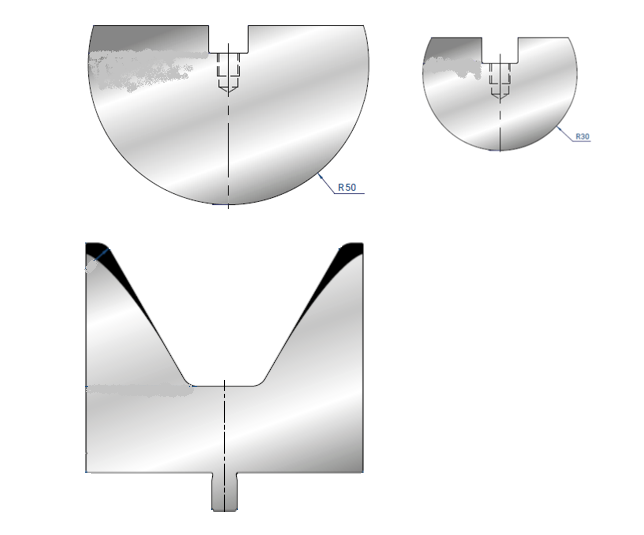
Discover the full range of Eurostamp's products for radius bending.
Eurostamp, more than 3700 clients worldwide.
Since 1970, Eurostamp has been manufacturing and selling top quality press brake tooling and equipment. Eurostamp designs standard and special tools. We have customers worldwide who choose us for our professionalism, skills, precision and fast delivery.