
 English
 Italiano
 Français
 Türkçe
Request quotation
The previous article focused on how important the shape of a press brake tool is in order to determine its strength and max. load, which is expressed in tons per meter (Ton/m).
This article highlighted that tools are considered to have a high level of strength if they:
- withstand crushing forces, as they have to bear the heavy loads applied in sheet metal bending
- withstand fatigue, as they have to resist the repetitive cycles of metal processing
- have good surface hardness, in order to resist the abrasion wear caused by sheet metal sliding.
Shape and strength.
LThe shape of tools influences the way the stress applied to their upper part is transmitted to the sheet metal though the punch tip.
According to their shape, punches are divided into two macro-categories:
- straight punches, where pressure goes down straight along the tool axis, parallel to it
- gooseneck punches, where pressure has to "follow" the shape of the tool, deviating before reaching the sheet metal
Because the distribution of pressure is different, straight punches have a higher strength than gooseneck punches.
The tool shape and the profile to be formed.
Besides providing different levels of strength, the shape of the punch to be used also depends on the bend profile that is to be formed. The choice is therefore influenced by the result we want to achieve. For example, the right tool to bend a "U" profile is a gooseneck punch. The next article is going to focus on this particular type of metalwork.
The evolution of shapes.
In time, and according to the most frequent uses, several shapes of tools have been designed, especially starting from the straight shape.
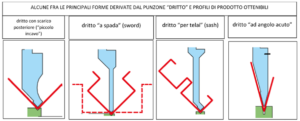
The most common strategy for creating new shapes is to remove material from the body of the punch, in order to increase its functionality. The goal is to be able to form many different bent profiles using the same tool.
However, it is worth considering that the more material is removed from the punch, the less strength it has. Any new shape always results from a compromise between flexibility and maximum strength. However, we also need to remember the "typical" thickness of the sheet metal used. It is clear that when using thicker material, we are less likely to be bending complex profiles or forming bends close together. This last type of metalwork is the main reason why it is common to remove material portions from straight punches. This prevents sheet metal from colliding with the body of the tool.
The figure below shows some of the shapes made from a straight punch, and the profiles you can bend by using them.
The next article, as already mentioned, is going to focus this analysis on the shapes needed to bend “U” profiles.
Eurostamp: achieving successes since 1970.
In 50 years in the business we have faced challenges and gained important rewards, reaching an amount of 3700 customers worldwide. Do you want to work with our top quality press brake tools?