
 English
 Italiano
 Français
 Türkçe
Request quotation
Choosing the best bending tools for our needs is not simple. We have already mentioned how important it is to lean on high quality tools, with specific characteristics.
Look into the 3 parameters to recognize a high quality tool.
The first fundamental aspect is the toughness of the press brakes tools. Not only can the tool’s toughness lead to better results, but it can also increase its wear protection, thus extending its durability.
In order to fulfil this requirement, the tools have to:
- bear the heavy loads applied in sheet metal bending
- resist the repetitive work cycles of metal processing
- resist the abrasive wear caused by sheet metal sliding.
In the previous article we saw how one of the factors providing the tools with these characteristics, thus increasing their toughness and durability, is the type of steel used to fabricate them.
In this article we are going to focus on how toughness and durability of tools can depend on a specific heat treatment. The heat treatment affects strength and abrasive wear protection.
Heat treatments carried out on steel. The strength value of a material can be increased by applying heat treatments. They, indeed, improve steel mechanical properties.
Hardening.
This process consists of heating metal to high temperatures and then cooling it rapidly.
Different results can be achieved also on the same material, both in terms of hardness (or strength) and of fragility, depending on:
- maximum hardening
- heating time
- cooling time.
Particularly, fragility is directly related to hardness value. A sheet of glass, for example, is extremely hard: if you try to bend it, it resists, until a certain amount of stress is exceeded and the sheet suddenly breaks.
What is the relation between strength and hardness?
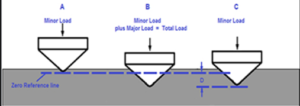
The strength of a material is its ability to withstand an applied load without failure or plastic deformation. It is determined though destructive testing, which implies the breaking of the part.
Conversely, the surface hardness is the ability to resist penetration. It is determined by indenting the material surface with a small indenter. "Core" hardness of the part, that is, the hardness of the material below the surface, is measured on a cross-section of the interior of the part.
In the case of metals, there is a direct relationship between the two values, which is measured experimentally and written in comparison charts. This allows to determine with good approximation the mechanical strength of a part, by measuring its hardness. This method has two advantages: it is quicker and it avoids breaking the part, which, as previously mentioned, would be inevitable in direct testing of strength.
Steels and heat treatments.
There are different heat treating processes, all aimed at changing the mechanical characteristics of steel. Each heat treatment has a different effect, and it is possible to carry out more than one treatment on the same part.
For this, it is fundamental for the tool manufacturer to carefully choose which treatments should be carried out, as well as which type of steel should be used. The right choice will add value to the final product.
Commonly used types of steel and possible heat treatments.
C45 Carbon Steel. Any heat treatment can be carried out. The ultimate tensile strength in the supply certifications is between 560-710 N/mm².
QUENCHED AND TEMPERED C45 Carbon Steel. Quenching and tempering can be carried out on this type of steel, that is, a hardening treatment followed by a tempering phase. This treatment increases the ultimate tensile strength to 800-850 N/mm², while maintaining a good compromise between hardness and toughness.
QUENCHED AND TEMPERED CrMo Chromium Molybdenum Steel. This steel is only supplied already quenched and tempered, which, as for C45, increases its mechanical strength. CrMo steel certified ultimate tensile strength is between 950 and 1050 N/mm².
Do you need any help?
Eurostamp provides bending training and helps you choose the best press brake tools for your bending needs. Since 1970 Eurostamp Tooling has been designing and manufacturing top quality tools for state-of-the-art press brakes, industrial punches and industrial dies, standard tools or special tools.
Contact Eurostamp.