
 English
 Italiano
 Français
 Türkçe
Request quotation
In this article we have started analyzing the different types of bending. They are: coining, hemming and air bending.
The present article is going to focus on the latter.
Air bending.
Air bending is also called "at three points", as in this type of bending, the material only touches the tool at three points:
- the punch tip
- the two die shoulders.
What is it?
In air bending, a punch presses the workpiece into the V-opening of the die. The bend angle is determined by how far the punch penetrates into the die.
Advantages of bottoming.
- Unlike coining, it is possible to bend high thickness sheet metal.
- Different angles can be made using the same tools. This is because, as we said, the bend angle depends on how far the punch goes into the die.
There are basically two types of air bending, according to how punch stroke is managed:
- partial bending
- bottoming.
Partial bending.
Partial bending allows to achieve a certain bend angle, according to how far the punch penetrates into the die.
The width of the V-groove:
- affects the amount of force needed to bend the material. With the same type and thickness of sheet metal, a wider V-groove means less resistance against the punch pressure.
- determines the internal bend radius.
Advantages of partial bending.
- It allows for a much lower amount of force needed compared to other bending methods, making it possible to also bend high thickness material
- different angles can be made using the same tools.
Disadvantages of partial bending.
In order to achieve a high level of accuracy, air bending requires high technology press brakes, because this type of bending is not so precise in determining the right punch stroke to compensate springback.
Bottoming.
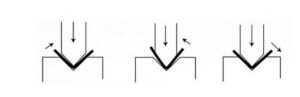
Bottom bending (bottoming) was born as an alternative way to overcome the limits of coining, because:
- it requires less tonnage
- it allows to overcome pressure limits of higher thicknesses
- it can compensate springback by bending the material to a more acute angle than the required result.
In this case, too, a 90° die is used, but it is penetrated by a punch with a narrower angle.
The machine completes a full stroke, so the punch must always press the material against the bottom of the die. By doing so, the punch deforms the material, forcing it to bend to a narrower angle than the die angle.
The width of the V-groove affects the amount of pressure needed to deform the sheet metal, but, as the material needs to be pressed against the bottom of the die, a higher amount of pressure is required in bottoming than in partial air bending.
Springback is compensated thanks to the difference between the die angle and the punch angle, together with the punch tip radius pressure on the sheet metal, which is already bottomed against the die.
The die "forces" the sheet metal to "over-bend" and make contact with the sides of the punch, and then it springs back against the die.
Once the operation is ended, the right angle is achieved.
In this case, only the punch tip radius makes contact with the metal, instead of the whole punch surface.
Advantages of bottoming. Higher bending accuracy.
Disadvantages of bottoming. As in coining, a higher amount of force is required than in partial bending, therefore it is not possible to perform bottoming on any thicknesses.
Do you have any special bending needs? Rely on Eurostamp Tooling to help you.