
 English
 Italiano
 Français
 Türkçe
Request quotation
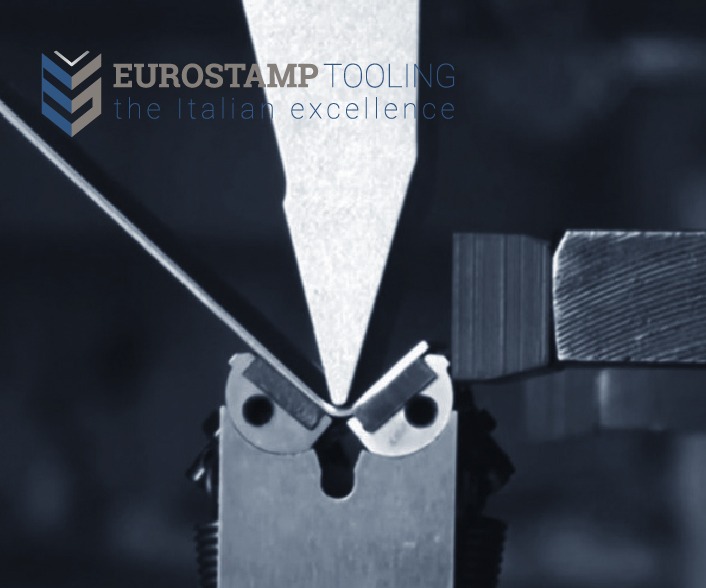
In the previous article, we introduced the concept of punch tip radius. We talked about it in relation to the earlier kinds of bending: coining and bottoming.
Let's now talk about the punch tip radius in relation to the most used kind of bending nowadays: air bending.

Air bending.
After the NC (Numerical Control) press brakes were introduced, it was possible to effectively control the stroke (Y axis), so the need to bend according to the earlier kinds (Coining and Bottoming) started to decrease. How can we compensate for springback? We can do it by using punches and dies that have angles less than 90° and adjusting the bend angle according to how deep the punch penetrates into the V groove of the die.
Why is it called "air" bending?
This kind of bending, which is vastly used on any machine today, is called "air" bending because "there is always air" passing between the bottom of the die and the lower side of the sheet metal. Sheet metal only touches the tooling at three points:
- the punch tip
- the two die shoulders.
In air bending, except when fabricating large radius bent profiles, the internal bend radius does not match the punch radius, as it depends on the width of the die groove.
All other conditions being equal, a larger die width will always fabricate a 90° bend, but the internal bend radius will be greater than the one achieved with a smaller die width.
The relation between die width and bend radius depends on several factors, the most important being the type of material used because according to it, the following characteristics will change:
- Ultimate Tensile Strength
- yield strength
- elongation rate.
Approximately, using a V width appropriate to the thickness (multiplying by 6, 8 or 12 times), the resulting radius will be between:
- 15% – 17% of the die width, when fabricating mild steel
- 20% – 22% of the die width, if you are fabricating stainless steel.
Theoretically, with a given die width, the internal bend radius is not dependent on the punch tip radius, provided that the punch tip radius is smaller than, or equal to, the radius created by the die width.
For example, an 8mm V-width (suitable for bending a 1mm thickness), when used for fabricating mild steel with UTS of about 450N/mm², will create an approximately 1.3mm internal bend radius, whether using a punch with a 0.25mm radius, or a 0.8mm radius or a 1mm radius.
Would you like some expert advice to choose the best tooling to suit your bending needs?
Eurostamp replies promptly to any queries and provides training support in bending. Since 1970, Eurostamp Tooling has been designing and manufacturing top quality press brake tooling, industrial punches and industrial dies.
Have a look at Eurostamp's Virtual Warehouse.