
 English
 Italiano
 Français
 Türkçe
Request quotation
Sheet metal bending is a very delicate process that must be performed with extreme precision to ensure that the part meets the design, but is also free of defects and brittleness.
Good bending requires the use of appropriate equipment, such as high-quality press brakes and tools. Indeed, there are factors that a good bender needs to consider, one of the most important being springback.
What is springback?
When bending sheet metal, as soon as you stop applying the force necessary to bend it, it tries to partially return to its original shape: this is the springback phenomenon.
Springback is due to the inherent elasticity of each material, which is the tendency of the material to resist deformation by returning to its original shape.
Springback in sheet metal bending.
In the field of sheet metal bending, springback is an ever-present factor and occurs with dimensional increase in the bending angle and radius.
What does springback depend on?
The amount of springback depends on several factors, such as:
- the type of material/alloy used;
- the thickness of the sheet;
- the angle of bending;
- the bending radius;
- the bending method used.
In general, the more ductile the metal, the greater the springback, just as a greater thickness or tighter bend angle will result in greater springback. The thicker the sheet and the narrower the bend angle, the greater the springback.
Why does springback occur?
Folded sheet metal has elastic properties that cause it to return to a shape that is as close as possible to the one before the force required to bend it was applied.
When a sheet is bent, it experiences internal stresses that cause elastic deformation.
When the force applied by the press is removed, these stresses are released and the sheet partially returns to its original shape.
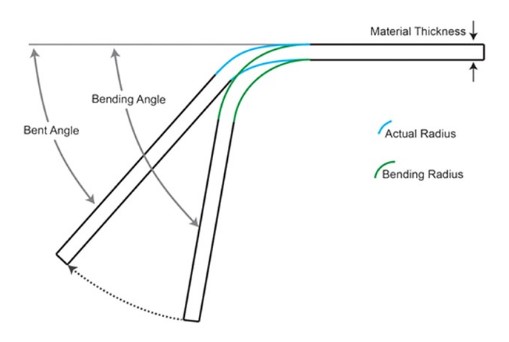
Springback and Machining Accuracy.
Springback can cause the final shape of the sheet to be different from the required shape. The result? An inaccurate finished product.
This must not happen because in many cases the product is a mechanical or structural part that must fit seamlessly into gears or components of appliances or machinery. For example, a part made for the aerospace industry must be exactly as designed or the entire system will fail.
As mentioned above, precision is critical.
Therefore, it is important to allow for springback during machining. This is the only way to achieve precise and accurate press brake bending results.
How do you compensate for springback?
To predict and correct for springback, a good bender must properly adjust the bend angle and the force applied during "air bending". This can be done manually or with more advanced press brakes that can automatically calculate the necessary correction based on the type of sheet being bent.
There are two other techniques that can be used to minimize springback:
- bottom bending or bottoming, which applies a higher force to the sheet from both sides, working directly on the sides of the die cavity;
- coining, which creates a precise and permanent bend in the sheet and is very similar to stamping; in this type of process, the punch and die must have the same angular dimension and the material thickness cannot be very large. The punch will "stamp" the sheet into the die, greatly reducing the springback of the material.
Both processes require much more force than "air bending" and will result in more wear and tear on the bending tools.

A key factor: the experience of the bender.
Sheet metal bending is a true art, based on experience and field testing.
The bender knows that springback can be minimized, but not completely avoided. So sheet metal bending must always take into account the necessary adjustments to achieve an accurate bend and a correct end product that meets the specifications and structural tolerances required by the customer.
Do you have special bending requirements?
Eurostamp Tooling has been manufacturing and marketing high quality bending tools and press brake tooling since 1970.